Tuesday, 3 May 2016

Sauk Village Police Department Report - April 26, 2016


Sauk Village Police Department


Board Meeting Report 04/26/2016

by Police Chief Robert Kowalski


-Police Service Case Summary:  During the period of 04/12/2016 thru 04/26/2016 the Sauk Village Police Department had a total of 20 arrests.  Of the arrests reported 10 were felony arrests and 10 were misdemeanor arrests.   

-CalCom Report: For a period between 04/12/2016 and 04/26/2016 the police department received 571 calls for service.

-Cases of Note:  

On 04/14/2016, Officers received a reported that an individual was stealing property from the garage on the 21600 block of Cynthia.  Upon investigation a witness identified the offender who was known to the police.  Through a follow up the officers found the offender and placed him under arrest and charged him with burglary.

On 04/15/2016, Officers were dispatched to the Family Dollar Store 2581 Sauk Trail for a possible burglary in progress.  Upon arrival Officers observed an offender climbing out a broken window in the front of the business and place him under arrest.  The offender was transported to the station and charged with burglary.

On 4/18/2016 the Police Department responded to a shooting that just occurred in the vicinity of 21700 block of Peterson.  The offender(s) shot in the direction of Assistant Chief Fire Investigator Ed Myers and Code Enforcement Officer Sue Dobrzeniecki who were at a home in that area.  Both Mr. Myers and Ms. Dobrzeniecki were not injured from the incident.  A search of the area found evidence which was collected and will be sent to the Illinois State Police Crime lab. The Officers searched the area for offenders with negative results.

It should be noted there was a shooting in the same area on 4/17/2016 in which there were several individuals involved.  Three of the individuals were shot with non-life threating wounds and drove themselves to St. Margaret’s Hospital.  When the on call Investigator interviewed the victims at the hospital one victim identified a subject who was allegedly involved.  When the investigator re-interviewed the victims no one had any information about who was involved in the shooting and they decided not to cooperate.  On 4/20/2016 while continuing their investigation detectives filed charges on an individual who was allegedly involved with the shooting.

On 04/20/2016, the South Suburban Emergency Response Team (SSERT) along with Sauk Village Police Officers executed a search warrant on the 2000 block of Sauk Trail. During the execution the Officers found a substantial amount of drugs and a gun.  The resident of the dwelling who was arrested is also a known felon. Another resident was inside the house and charged with possession of drug equipment.  The male offender was charged with several possession of narcotics charges.

On 04/24/2016 Officers were responding to a call of a domestic dispute on the 200 block of Park Lane.  Upon arrival Officers learned a female victim at the residence was asleep only to be awaken by 2 males sexually abusing her.  Both subjects were taken into custody and the on call investigator was called.  Through the investigation charges of Aggravated Criminal Sexual Assault was approved by the States Attorney's office.

-Training:  On April 21 and 22 I attended the Illinois Association of Chief of Police conference in Schaumburg. The conference was well attended and provided information that we will use to benefit the police department.  Also two officers attended the Truck Enforcement School through the North East Multi Regional Training Group (NEMERT) and found it to be a very good training class. We will be sending more officers to future classes. Lastly, Officers will be qualifying in accordance to the Illinois Law Enforcement Training and Standards Board (ILETSB) on April 27th at the Will County Sheriff's Academy range.
-Staffing: The Officer hired to fill the COPS Grant will be graduating from the Chicago Police Academy on May 6th.  The Officer replacing Ofc. Jacob Howard has passed all the preliminary hiring tests and will be offered the position within the next coming days.
-CalCom Outage: On April 19th it was reported that the CalCom Dispatch Center experienced a telephone outage.  After learning of this incident I checked and found that CalCom had been testing their texting program which might have caused the non-emergency lines to experience a sporadic outage.  I was told that during this time did the emergency system nor the radio system fail.  CalCom sent a detailed letter explaining the situation which attached below.


-Equipment: As reported in a previous report the mobile computers were in the process of being installed in the squads.  Six squads have been equipped with the mobile computers, one squad has an old computer mount and needs to be swapped out. There is still a software issue that is being worked on. Lastly, I would like to make note that although the officers might not have full access to the computers in their vehicles this does not stop them from doing their job.  The laptops are an added tool that the officers can use to assist in their daily duties. 

End Report.


21 April 16
To:                    JW  Fairman, Director of Public Safety Sauk Village
From:                 Mark Davis, Executive Director Cal-Comm
Subject:             AT&T and T-Mobile Telephone Carriers Testing
            On 19 April 2016 AT&T and T-Mobile conducted test for Texting to 911 from specified locations within the Village of Calumet Park and Sauk Village beginning at 12:30PM.  Technicians were sent to locations in both municipalities to conduct test to determine the strength of the signal from their locations within the boundaries of the Villages.  The tests begin at 12:30 and the technician sent a text to Cal-Comm from a location in the Village.  At 12:44 pm while sitting in front of a console in the communication Center, we noticed a blip on the screen which indicated that a problem existed and our non-emergency line went down.  
We immediately contacted Chi-Comm to report the incident.  Further test continued and the technician in Sauk Village began to conduct a test in Sauk Village and again we noticed a recurrence of the same problem.  T-Mobile and AT& T stated they were not aware of the problem and the test had nothing to do with that problem.  All tests were concluded by 1300 hours and the Text to 911 from both municipalities was successful.  The technician from Chi-Comm arrived but the problem was not occurring at the time of his arrival.  During that time we received 2 emergency calls from Sauk Village and they were properly addressed.
During the testing process, at no time did the emergency 911 lines shut down and we maintained our ability to dispatch 911 emergency calls to both the Village of Calumet Park and Sauk Village
Mark Davis


This Day In History - May 3rd


1980
MADD Founder’s Daughter Killed by Drunk Driver


On this day in 1980, 13-year-old Cari Lightner of Fair Oaks, California, is walking along a quiet road on her way to a church carnival when a car swerves out of control, striking and killing her. Cari’s tragic death compelled her mother, Candy Lightner, to found the organization Mothers Against Drunk Driving (MADD), which would grow into one of the country’s most influential non-profit organizations.


When police arrested Clarence Busch, the driver who hit Cari, they found that he had a record of arrests for intoxication, and had in fact been arrested on another hit-and-run drunk-driving charge less than a week earlier. Candy Lightner learned from a policeman that drunk driving was rarely prosecuted harshly, and that Busch was unlikely to spend significant time behind bars. Furious, Lightner decided to take action against what she later called “the only socially accepted form of homicide.” MADD was the result. (Charged with vehicular homicide, Busch did eventually serve 21 months in jail.)


In 1980–the year Cari Lightner died–some 27,000 alcohol-related traffic fatalities occurred in the United States, including 2,500 in California alone. After founding MADD, Lightner began lobbying California’s governor, Jerry Brown, to set up a state task force to investigate drunk driving. Brown eventually agreed, making her the task force’s first member. In 1981, California passed a law imposing minimum fines of $375 for drunk drivers and mandatory imprisonment of up to four years for repeat offenders.

President Ronald Reagan soon asked Lightner to serve on the National Commission on Drunk Driving, which recommended raising the minimum drinking age to 21 and revoking the licenses of those arrested for drunk driving. In July 1984, she stood next to Reagan as he signed a law reducing federal highway grants to any state that failed to raise its drinking age to 21 (a change that was estimated to save around 800 traffic deaths annually); by the following year, all 50 states had tightened their drunk-driving laws.


MADD had expanded to some 320 chapters and 600,000 volunteers and donors nationwide by 1985, when Lightner parted ways with the organization. MADD went on to wage a campaign to lower the nation’s legal blood alcohol content from 0.1 percent to 0.08.

The group won a major victory in 2000, when the Clinton administration passed a law tying federal highway funds to states’ adoption of the 0.08 standard. By that year–the 20th anniversary of MADD’s founding–alcohol-related fatalities had dropped some 40 percent over two decades, and states with the toughest drunk-driving laws were beginning to treat alcohol-related fatalities as murder.

Monday, 2 May 2016

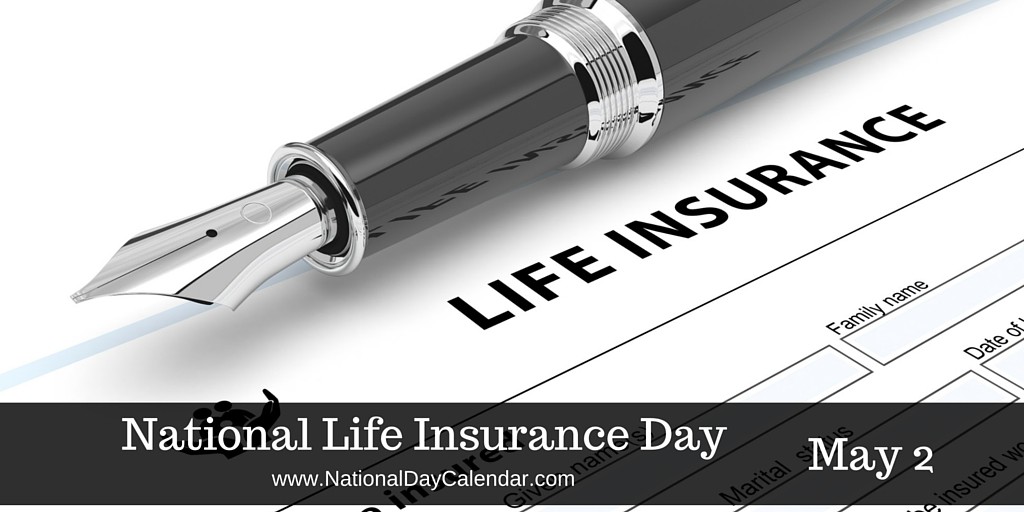
NATIONAL LIFE INSURANCE DAY - May 2, 2016


NATIONAL LIFE INSURANCE DAY

National Life Insurance Day is observed annually on May 2nd.  This day marks the anniversary of the first day life insurance became available in the United States.


The sale of life insurance in the U.S. began in the late 1760s. The Presbyterian Synods in Philadelphia and New York City created the Corporation for Relief of Poor and Distressed Widows and Children of Presbyterian Ministers in 1759.


On May 2, 1759, the charter was recorded for the Corporation for Relief of Poor and Distressed Widows and Children of Presbyterian Ministers. Episcopalian priests created a comparable relief fund in 1769. Between 1787 and 1837 more than two dozen life insurance companies were started, but fewer than half a dozen survived.


Life insurance can do some pretty amazing things for people. It can buy loved ones time to grieve. It can pay off debts and loans, providing surviving family members with the chance to move on with a clean slate. It can keep families in their homes and pre-fund a child’s college education. It can keep a family business in the family. It can provide a stream of income for a family to live on for a period of time.

NATIONAL TRUFFLE DAY - May 2nd


NATIONAL TRUFFLE DAY


National Truffle Day is observed annually on May 2nd.  On this day, the deliciously sweet chocolate truffle gets the spotlight.


This chocolate confectionery is traditionally made with a chocolate ganache center coated in chocolate, icing, cocoa powder, chopped nuts or coconut.  The truffle may be filled with other fillings such as cream, melted chocolate, caramel, nuts, fruit, nougat, fudge, toffee, mint, marshmallow or liqueur.

This Day In History - May 2nd


2011
Osama bin Laden killed by U.S. forces


On this day in 2011, Osama bin Laden, the mastermind behind the September 11, 2001, terrorist attacks in the United States, is killed by U.S. forces during a raid on his compound hideout in Pakistan. The notorious, 54-year-old leader of Al Qaeda, the terrorist network of Islamic extremists, had been the target of a nearly decade-long international manhunt.


The raid began around 1 a.m. local time, when 23 U.S. Navy SEALs in two Black Hawk helicopters descended on the compound in Abbottabad, a tourist and military center north of Pakistan’s capital, Islamabad. One of the helicopters crash-landed into the compound but no one aboard was hurt. During the raid, which lasted approximately 40 minutes, five people, including bin Laden and one of his adult sons, were killed by U.S. gunfire. No Americans were injured in the assault. Afterward, bin Laden’s body was flown by helicopter to Afghanistan for official identification, then buried at an undisclosed location in the Arabian Sea less than 24 hours after his death, in accordance with Islamic practice.


Just after 11:30 p.m. EST on May 1 (Pakistan’s time zone is 9 hours ahead of Washington, D.C.), President Barack Obama, who monitored the raid in real time via footage shot by a drone flying high above Abbottabad, made a televised address from the White House, announcing bin Laden’s death. “Justice has been done,” the president said. After hearing the news, cheering crowds gathered outside the White House and in New York City’s Times Square and the Ground Zero site.


Based on computer files and other evidence the SEALs collected during the raid, it was later determined that bin Laden was making plans to assassinate President Obama and carry out a series of additional attacks against America, including one on the anniversary of September 11, the largest terrorist attack ever on U.S. soil, which left nearly 3,000 people dead. Shortly after the 2001 attack, President George W. Bush declared bin Laden, who was born into a wealthy family in Saudi Arabia in 1957 and used his multi-million-dollar inheritance to help establish al Qaeda and fund its activities, would be captured dead or alive. In December of that year, American-backed forces came close to capturing bin Laden in a cave complex in Afghanistan’s Tora Bora region; however, he escaped and would continue to elude U.S. authorities for years.


A break in the hunt for bin Laden came in August 2010, when C.I.A. analysts tracked the terrorist leader’s courier to the Abbottabad compound, located behind tall security walls in a residential neighborhood. (U.S. intelligence officials spent the ensuing months keeping the compound under surveillance; however, they were never certain bin Laden was hiding there until the raid took place.)
The U.S. media had long reported bin Laden was believed to be hiding in the remote tribal areas along the Afghan-Pakistani border, so many Americans were surprised to learn the world’s most famous fugitive had likely spent the last five years of his life in a well-populated area less than a mile from an elite Pakistani military academy.


After the raid, which the U.S. reportedly carried out without informing the Pakistani government in advance, some American officials suspected Pakistani authorities of helping to shelter bin Laden in Abbottabad, although there was no concrete evidence to confirm this.

Sauk Village Administrator/Public Safety Director - April 26, 2016


Administrator /Public Safety Director’s Report


April 26, 2016


URC Reported Crime:


No Report
Vacant Housing:
The Village’s master vacant list (as of April 26, 2016) shows 436  vacant homes:
  • Vacant                       - 389 houses

  • Vacant/Occupied     - 39 houses

  • Demo list                   -  8 houses 


Scavenger Contract Update:
  • Our scavenger contractor has sent the Village an action plan that staff and our attorney’s will review before determining the Village’s liability to the vender. However, Staff has determined that people who do not pay their garbage bill cost the Village approximately $43,800 annually. NOTE: Water, sewer, utility tax and garbage are combined billings; there are currently 230 overdue billings costing the Village an estimated $36,940 bi-monthly.

Water Accounts
  • No Report

Ordinance/Resolutions/ Amendments:  
  • Staff Recommendation for Village Police Tow penalties be set aside by ordinance in a dedicated fund for Police vehicle purchases or related costs have been prepared by our attorneys and is being reviewed by the SVPD.

  • Staff Attorneys have prepared a letter for the mayor to the Village Treasurer removing him from his duties.

  • Staff Recommendation for Vehicles found on property identified by the Village as Vacant be stickered, ticketed and towed by the SVPD within 48 hours is still under review by our attorneys.

  • Staff recommendation for “After Hours Turn on Fee” be increased to $250, “Before Hours Turn on Fee” be increased to $200. This proposal has been prepared by our attorneys and sent to the Public Works Committee on 4/11/16 for recommendation. The Public Works Committee has recommended that fees be increased to $120 and $100 respectively. Our attorneys will prepare the recommended amendment for the 1st Board meeting in May.

  • Staff Recommendation for request not to exceed $15,000 to update the “Civic” computer system on all financial components of the Village has been completed by our attorneys and sent to the Finance Committee on 4/12/16.

  • 50% of collected debt derived from water/sewer/disposal and utility taxes shall be set aside in a reserve fund for the purchase of Public Works Vehicles or related capital cost is still under review by our attorneys.
Miscellaneous:
  • Owens Group has completed its 2nd review of the Employees’ Handbook and are reviewing the Village’s labor contracts to assure against conflicts of interest.

  • Staff continues to review employee insurance coverage and interviewing insurance groups to assure that Sauk Village is receiving the best coverage at a competitive cost. Staff will make a proposal to the Board when the review is completed.
Budget:
Is in the process of ten day public review.


Sunday, 1 May 2016

National Day of Prayer - May 5, 2016


The First Thursday of May

The National Day of Prayer is an annual observance held on the first Thursday of May, inviting people of all faiths to pray for our nation. It was created in 1952 by a joint resolution of the United States Congress and signed into law by President Harry S. Truman. Since its inception, this day has continually united Americans from all socio-economic, political, and ethnic backgrounds in prayer while also encouraging personal repentance and righteousness in the culture. The National Day of Prayer belongs to all Americans and is a day that transcends differences, bringing together citizens to celebrate our most beloved freedom; the freedom to humbly come before God and seek His guidance in prayer.


First Call of Prayer in 1775

Because of the faith of many of our founding fathers, public prayer and national days of prayer have a long-standing and significant history in American tradition. The Supreme Court affirmed the right of state legislatures to open their sessions with prayer in Marsh vs. Chambers (1983).
The National Day of Prayer is a vital part of our heritage. Since the first call to prayer in 1775, when the Continental Congress asked the colonies to pray for wisdom in forming a nation, the call to prayer has continued through our history, including President Lincoln’s proclamation of a day of “humiliation, fasting, and prayer” in 1863. In 1952, a joint resolution by Congress, signed by President Truman, declared an annual national day of prayer. In 1988, the law was amended and signed by President Reagan, permanently setting the day as the first Thursday of every May. Each year, the president signs a proclamation, encouraging all Americans to pray on this day. Last year, all 50 state governors plus the governors of several U.S. territories signed similar proclamations.


Significance of the National Day of Prayer

The National Day of Prayer has great significance for us as a nation as it enables us to recall and to teach the way in which our founding fathers sought the wisdom of God when faced with critical decisions. It stands as a call for us to humbly come before God, seeking His guidance for our leaders and His grace upon us as a people. The unanimous passage of the bill establishing the National Day of Prayer as an annual event, signifies that prayer is as important to our nation today as it was in the beginning.
Like Thanksgiving or Christmas, this day has become a national observance placed on all Hallmark calendars and observed annually across the nation and in Washington, D.C. Every year, local, state, and federal observances were held from sunrise in Maine to sunset in Hawaii, uniting Americans from all socio-economic, political and ethnic backgrounds in prayer for our nation. It is estimated that over two million people attended more than 30,000 observances – organized by approximately 40,000 volunteers. At state capitols, county court houses, on the steps of city halls, and in schools, businesses, churches and homes, people stopped their activities and gathered for prayer.


The National Day of Prayer is Ours

The National Day of Prayer belongs to all Americans. It is a day that transcends differences, bringing together citizens from all backgrounds. Mrs. Shirley Dobson, NDP chairman, reminds us: “We have lost many of our freedoms in America because we have been asleep. I feel if we do not become involved and support the annual National Day of Prayer, we could end up forfeiting this freedom, too.”


Historical Summary

  • 1775 – The first Continental Congress called for a National Day of Prayer
  • 1863 – Abraham Lincoln called for such a day.
  • 1952 – Congress established NDP as an annual event by a joint resolution, signed into law by President Truman (82-324)
  • 1988 – The law was amended and signed by President Reagan, designating the NDP as the first Thursday in May (100-307).


Fun Facts

  1. There have been 144 national calls to prayer, humiliation, fasting and thanksgiving by the President of the United States (1789 – 2015).
  2. There have been 67 Presidential Proclamations for a National Day of Prayer (1952 – 2015). Gerald R. Ford (1976), George H. Bush (1989 – 91) and Barack H. Obama (2012) are the only U.S. Presidents to sign multiple National Day of Prayer Proclamations in the same year.
  3. Every President since 1952 has signed a National Day of Prayer proclamation.
  4. 34 of the 44 U.S. Presidents have signed proclamations for National Prayer. Three of the Presidents who did not sign a proclamation died while serving in office. Two Presidents, not included in the count—William Howard Taft and Warren Gamaliel Harding, signed proclamations for Thanksgiving and Prayer.
  5. Records indicate there have been 1,419 state and federal calls for national prayer since 1775 and counting.

This Day In History - May 1st


1931
Empire State Building Dedicated


On this day in 1931, President Herbert Hoover officially dedicates New York City’s Empire State Building, pressing a button from the White House that turns on the building’s lights. Hoover’s gesture, of course, was symbolic; while the president remained in Washington, D.C., someone else flicked the switches in New York.


The idea for the Empire State Building is said to have been born of a competition between Walter Chrysler of the Chrysler Corporation and John Jakob Raskob of General Motors, to see who could erect the taller building. Chrysler had already begun work on the famous Chrysler Building, the gleaming 1,046-foot skyscraper in midtown Manhattan. Not to be bested, Raskob assembled a group of well-known investors, including former New York Governor Alfred E. Smith. The group chose the architecture firm Shreve, Lamb and Harmon Associates to design the building. The Art-Deco plans, said to have been based in large part on the look of a pencil, were also builder-friendly: The entire building went up in just over a year, under budget (at $40 million) and well ahead of schedule. During certain periods of building, the frame grew an astonishing four-and-a-half stories a week.


At the time of its completion, the Empire State Building, at 102 stories and 1,250 feet high (1,454 feet to the top of the lightning rod), was the world’s tallest skyscraper. The Depression-era construction employed as many as 3,400 workers on any single day, most of whom received an excellent pay rate, especially given the economic conditions of the time. The new building imbued New York City with a deep sense of pride, desperately needed in the depths of the Great Depression, when many city residents were unemployed and prospects looked bleak. The grip of the Depression on New York’s economy was still evident a year later, however, when only 25 percent of the Empire State’s offices had been rented.


In 1972, the Empire State Building lost its title as world’s tallest building to New York’s World Trade Center, which itself was the tallest skyscraper for but a year. Today the honor belongs to Dubai’s Burj Khalifa tower, which soars 2,717 feet into the sky.

Sauk Village Senior Committee Report - April 26, 2016


Sauk Village Senior Committee Report

April 26, 2016


FREE Blood Pressure screening for all village residents and village employees from 1:00-2:00 p.m. in the Senior Center office on Monday, May 2nd and every first Monday.


Senior Committee co-sponsors FREE BP screening (12:00 p.m.) and movie “Private Benjamin’ (12:30 p.m.) at McConathy Library on Monday, May 9th.  Light refreshments provided by McConathy Library  and/or bring your own brown bag lunch.


Senior Committee Open Senior Activity looking for more participates every Friday 12:30-3:30 p.m. with coordinators Steve Shymkus and Frank Williams.  Seniors 50 years young are all welcome!  No meeting, no membership and no dues, just come and join the fun with your peers.  Light refreshment and bottled water served.


Bloom Township Senior Department still has openings for  trips scheduled:  May 26 Majestic Star Casino; and September 25 – October 1 Myrtle Beach Show trip and Charleston, S.C.   Mark your calendar for the annual picnic Thursday, August 4th, see flyer for details.  For additional information call the Senior Department (708) 754-9400.


Village Senior, watch for a flyer regarding a special FREE meal Saturday, May 21st in the afternoon.
The Senior Committees next meeting is Thursday, May 12th at 7:00 p.m. 

Saturday, 30 April 2016

This Day In History - April 30th


1789
George Washington Gives First Presidential Inaugural Address


On this day in 1789, George Washington is sworn in as the first American president and delivers the first inaugural speech at Federal Hall in New York City. Elements of the ceremony set tradition; presidential inaugurations have deviated little in the two centuries since Washington’s inauguration.


In front of 10,000 spectators, Washington appeared in a plain brown broadcloth suit holding a ceremonial army sword. At 6′ 3, Washington presented an impressive and solemn figure as he took the oath of office standing on the second balcony of Federal Hall. With Vice President John Adams standing beside him, Washington repeated the words prompted by Chancellor Robert R. Livingston, kissed the bible and then went to the Senate chamber to deliver his inaugural address.


Observers noted that Washington appeared as if he would have preferred facing cannon and musket fire to taking the political helm of the country. He fidgeted, with his hand in one pocket, and spoke in a low, sometimes inaudible voice while he reiterated the mixed emotions of anxiety and honor he felt in assuming the role of president. For the most part, his address consisted of generalities, but he directly addressed the need for a strong Constitution and Bill of Rights and frequently emphasized the public good. He told the House of Representatives that he declined to be paid beyond such actual expenditures as the public good may be thought to require. In deference to the power of Congress, Washington promised to give way to my entire confidence in your discernment and pursuit of the public good.


After delivering his address, Washington walked up Broadway with a group of legislators and local political leaders to pray at St. Paul’s Chapel. Later, he made the humble and astute observation that his presidency, and the nation itself, was an experiment.


Bonus Story


1939
New York World’s Fair opens


On April 30, 1939, the New York World’s Fair opens in New York City. The opening ceremony, which featured speeches by President Franklin D. Roosevelt and New York Governor Herbert Lehman, ushered in the first day of television broadcasting in New York.


Spanning 1,200 acres at Flushing Meadow Park in Queens, the fairground was marked by two imposing structures–the “Perisphere” and the “Trylon”–and exhibited such new technology as FM radio, robotics, fluorescent lighting, and a crude fax machine. Norman Bel Geddes designed a Futurama ride for General Motors, and users were transported through an idealized city of the future. Sixty-three nations participated in the fair, which enjoyed large crowds before the outbreak of World War II interrupted many of its scheduled events.